My first post took us through the first half of Belgium and Berlin. Now, on to Bavaria and our last few days in Belgium.
 Lunch at Augustiner Keller in Munich was probably one of my favorite meals. We each had an Augustiner Edelstoff, a helles lager, mine in a 1/2 liter glass, Jesse's in the full-on Mass. We each ordered sausage, little pork sausages are in the back with sauerkraut, and in the foreground are the käsekraner (cheese sausages) with potato salad. First of all, the potato salad and sauerkraut were life altering. They may look sort of blob-ish in this photo, but were the best tasting sides I've ever had. Secondly, if you've ever read my blog, you know that I love Corralitos sausages, particularly their Cheesy Bavarian. Well, folks, this is the original Cheesy Bavarian and Corralitos is pretty dead on.
 We actually ate quite a few pastries along the way, most of which I never bothered to photograph. Overall, the sweets were quite good in both Belgium and Germany, even ones from chains or mediocre train station kiosks were well above average. This one in particular from the Hofpfisterei in Munich's main train station, called Mohnstreusel, was outstanding. The dough reminded me of a king cake, sort of yeasty and only slightly sweet, with a lightly sweet poppy seed paste rolled in the middle, and a sweet crumb topping.
 The trip to Kloster Andechs (monastery) just outside of Munich was amazing on so many levels. The hike out to the monastery was refreshing, the chapel was breath-taking, and the food and beer were top notch. We shared a pork knuckle that seemed almost as big as my head and each had two 1/2 liters of beer. I started out with the Andecher Weissbier Helles (a wheat beer) and Jesse jumped right into the Doppelbock Dunkel (a darker beer). We both enjoyed the Dunkel so much that we each got another. It was probably my favorite beer in Germany.
 In Regensburg, we stopped at Spital Brewery for a snack and tasty beverage. I was sad that they didn't have pretzels, so we ordered (what I thought was a fresh cheese dip with veggies). As it turns out, the bell peppers were more of a facilitator to the pound of cream cheese stuffed inside. I didn't complain, it was very good fresh cream cheese, although I thought Jesse and I might fight over the lettuce and tomato garnish. By this point in the trip we craved vegetables.
 That night we had dinner in the apartment rented for the night. We picked up a cucumber, fresh bread, cheese, and pickled vegetables for a light meal. It was accompanied by two local beers, Wettenburger Kloster Barock Dunkel and Bischofshof Hefeweisbier Dunkel that only cost €.80 each. I love local beer! We found that the hefe went really well with the cheese.
  This meal in Bamberg was the straw that broke the camel's back (or my stomach). We rolled into Bamburg hungry and sleepy and headed straight for Spezial Brewery for lunch. Don't get me wrong, it was delicious, but the roast wild rabbit in a delicious gravy with a giant knödel (a potato dumpling) and cooked red cabbage was quite a lot of food to handle at lunchtime. Jesse had a pork roast that also came a dumpling and creamed broccoli. As if the food wasn't enough to knock us down for the afternoon, we washed it back with a 1/2 liter of beer (apparently the smallest glass you can obtain in Bavaria). Jesse got Spezial's specialty, the Rauchbier (smoke beer), and I got a Märzen. The food and drink filled my stomach, legs, and eyelids with sand. We both dragged ourselves around town for the rest of the day. I was officially over German food.
 On our long train ride (around 10 hours of traveling) back to Belgium, we had a 2-hour layover in Köln. It was insanely cold there and I really didn't want to have anymore beer for the rest of my life, but we pressed on and found a cafe to try a kölsch -- a local specialty. Thankfully the cafe, Früh am Dom, only poured their kölsch in .2 liter glasses. It was the perfect amount for the hour (just a few minutes after 11am).
 Our final destination, Ghent, Belgium was all about relaxation. For two nights we made our own dinner at the B&B, which consisted of a ton of fresh salad greens, fresh bread, cheese, and of course, beer. Kasteel (shown in the photo) was actually one of my least favorites of the trip. It was pretty high-octane at 11% abv, but syrupy sweet to the point of almost being nauseating.
 Belgium smelled like waffles (and sometime sewers, but mostly waffles). It's a sweet, buttery, delicious smell and I couldn't get enough. We got waffles from a vendor in Ghent and they were probably the most spectacular waffles that I've ever tasted, or will ever taste again. They're not airy like American waffles, but a dense, slightly sweet, brioche type dough. It's cooked in the waffle iron with sugar on the outside that slightly burns and crisps. With the hazelnut chocolate sauce, I could have died happy right there.
  The last night in Ghent, we went out with a bang by ordering mussels cooked in white wine. Prior to the mussels, we shared an order of shrimp croquettes and another abbey ale. I learned the next morning that 1/2 an appetizer and mussels does not a dinner make, especially when paired with stark Belgian brews. At breakfast my head and stomach were telling me that I might have chugged a glass full of gasoline, rather than that Duvel with our meal. It was a wonderful trip, but I knew right then that I was ready to go home.
As I sit at my kitchen table with the window open, the delicious smell of cooking bacon keeps drifting in and out of the apartment. Voila! The first category for my photo posts from the trip: Food. This is probably the best place to start, since an overarching theme during our 2-week trip to Germany and Belgium was food and beer. The main point of our trip (in addition to seeing incredible places) was to sample the wide range of fares that the two countries had to offer.
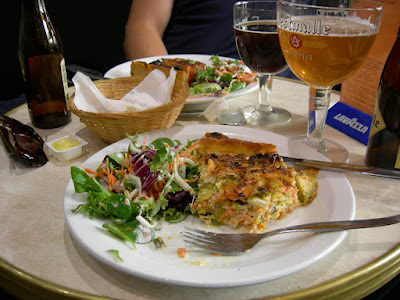 We stopped in a French cafe that appeared to specialize in tarts, both sweet and savory. Mine was leek and salmon and Jesse's was mushroom and tomato. We each had a Trappist beer with our lunch. I chose the Westmalle Tripel and Jesse's was Rochefort 10, each packing a punch at 9.5% and 11.3% abv. We quickly learned, however, that a beer (especially those potent ones) at lunch made for a very sleepy afternoon.
 We only went on one brewery tour, which happened to be at our first stop in Brussels. Cantillon brewery is located on the west side of town, in a bit of a transitional neighborhood, but was well worth the trip. It has been owned and run by the Van Roy-Cantillon family since 1900 and it shows. The pride in their product and process was inescapable throughout our entire visit, especially with the care and detail with which they described the beer as "acidic" not "bitter." After the tour we tasted two of their beers, the Gueuze and Kriek. Both were dry, sour, and definitely not sweet like other Kriek beers. It is definitely a beverage that you would sip on a special occasion, not unlike a very dry champagne. Before returning home, we purchased a bottle of their Lou Peppe Framboise that we'll hold on to for our next anniversary. I kind of like the idea of celebrating with beer instead of wine.
 In Bruges, we wanted to experience authentic Flemish cuisine, so we went to a restaurant that came highly recommended by the hostess at our guesthouse. We arrived at 5pm, which according to the front door was the time they opened for dinner, but the owner quickly assured us that they didn't actually open until 6pm. We returned an hour later and were lucky enough to find a table, as nearly the entire restaurant was booked for the evening. I ordered the Waterzooi (a chicken stew with potatoes) and Jesse ordered the beef stew (I can't remember the Dutch name). His came with a baked potato with curried butter melting inside. It was the most fantastic thing I've tasted in a while. We told the owner how much we loved the beef stew and he hustled down to the kitchen to provide us with a recipe! As soon as the weather cools down, I'm going to try and replicate the meal.
 After our delicious (and filling) Flemish meal, we walked around Bruges as the sun went down and I took a few night photos. Then, we ended up at Brugs Beertje, a bar that was recommended in our Good Beer Guide Belgium. The atmosphere was relaxed and I was kind of envious of the people who had brought games like cards and Pass the Pigs to play while sipping their beer. Jesse and I sampled two more Trappist ales, the Achel Blonde and Bruin. I love Trappist beers, so I had no complaints other than the fact that I wanted to pass out from the full beer and meal.
  This was our first breakfast in Berlin and pretty much summed up our breakfasts for the remainder of the trip. I was in heaven. When given the option of sweet or savory for breakfast, I always choose the latter. In fact, the best breakfast in my book is last night's leftovers with an egg on top. So, bread, cured meats, cheese, butter, tomatoes and pickles was a-okay with me!
  This was breakfast the second day in Berlin. We had a lot of sandwiches in Germany, but they were consistently delicious whether they had egg and cucumber, or just a variety of cheeses, or curried chicken. I know this photo is a little out of focus, but look at that bread! The bread in Germany was out of this world. Even in Portland, where we have fabulous bakeries, you just can't get rolls of this caliber. Also, schnitzel for breakfast is divine.
 Snacks were essential. Our best days incorporated snacks. This was a break in the Tiergarten in Berlin. We purchased the melba toast and cheese called Partykaas (which roughly translated into "party cheese") in Belgium for the plane ride to Germany. I loved the idea of party cheese so much that we even had a little Partykaas dance when I would reach into the backpack. Also, Kinder chocolates are delicious -- Bueno was a big hit.
 On the last night in Berlin, we finally got Döners. I think the picture speaks more to their deliciousness than I ever could.
That pretty much sums up the first few days of our trip. More to come tomorrow in European Road Food Part 2!
Friday, September 11th
 Today we're taking day trip to Andechs, a small town southwest of Munich. Since I have already visited Neuschwanstein Castle (built by Lugwig II in 1868 and inspiration for Disney's Cinderella Castle), I decided that a different, but equally as enjoyable day trip would be in order. In addition to absorbing the spectacular views of the Alps, the main reason for our visit is to experience Andechs Monastery. The Benedictine abbey is situated on the Holy Mountain near the Amersee in Bavaria's five lakes region and according to one of my guides, "Come [to Andechs] ready to eat tender chunks of pork, huge pretzels, spiraled white radishes, savory sauerkraut, and Andecher monk-made beer that would almost make celibacy tolerable." I'm sold. We will take a train to Herrshing and then take a 3-mile hike to Andechs. Don't worry, there's a bus route too if we don't feel like making the trek back to the train station. There's not much to do other than explore the cathedral and brewery, sit at the cafe and enjoy delicious food, and drink some of the best beer in Germany.
 As for Andechs' history, an unverifiable source claims that between 880 and 940 AD, an ancestor of the Count of Andechs returned from the holy land with sacred relics for the castle chapel. However, the name "Andechs" doesn't appear in historical documents until 1080. The first documented pilgrimage to the chapel at Andechs Castle isn't until 1128, which also coincides with Count Bertold II requiring the most pious under his governance make an annual pilgrimage.
Scandal first hits Andechs in 1208 when King Philip II of Swabia is murdered by Otto of Wittlesbach -- members of the House of Andechs are implicated for complicity in the murder, but were later acquitted and "rehabilitated". The Andechs clan tore down the original castle and moved their things up the road (presumably to escape humiliation). In 1423, Duke Ernest I initiates construction of a gothic cathedral. He deems the hill on which the cathedral rests "Heiliger Berg" (Holy Mountain) and the Benedictine church is once again a spot for pilgrimages.
Shortly before his death in 1438, Duke Ernest erects a convent for priests, which is where this part of the story gets good. His successor, Duke Albrecht III establishes the Andechts Benedictine Monastery in 1455. Let the brewing begin! Basically, the rest is a familiar history shared with many buildings in Germany: lightning strikes, building burns down and is rebuilt; gothic is totally out, cathedral is remodeled in Rococo style; new ownership, liquidation sale, beer making carries on, albeit under new name; post-war inhabitants see err of their ways and restore, restore, restore.
Thursday, September 10th
 Today we had a late morning flight from Berlin to Munich and will spend the afternoon exploring the areas immediately surrounding our hotel. Luckily, I found a well-regarded Pension right in the middle of things and can't wait to take it slow after our activity-driven week in Brussels, Bruges, and Berlin.
Munich was sort of a late bloomer in terms of German city standards, as it was founded at the late date of 1158 by a powerful Saxon duke. The duke, Guelph Henry the Lionheart, built a bridge over the river Isar to Munich, which at the time was inhabited only by a group of Benedictine monks. I guess not enough people were using (and paying tolls on) his bridge, so Henry destroyed a nearby crossing in Freising to force traders into Munich. While his plans were very effective, it proved to be political suicide. The Lionhearted Henry was put on trial and in 1180, Otto Wittelsbachs became duke of Bavaria -- the Wittlesbachs continued to rule Bavaria 1918. Between 1330 and 1430, two devastating fires burned down all (or significant parts of) the city that were eventually rebuilt.
In 1506, Munich became the capital of united Bavaria dukedom and remained a relatively modest town. Through a complicated European history and line of ownership, Napoleon granted Munich's expansion as a royal capital in the 19th century with planned boulevards and squares. Munich flourished during this time, acquiring a railway, electricity, and the Technical University. It was also one of the largest continental European cities at the time. World War I and II proved to be rough on Munich, and large portions were damaged by air raids. Following the American occupation in 1945, Munich was meticulously rebuilt, preserving it's pre-war street plan and appearance. Unfortunately, none of the guides I've read have elaborated on exactly which parts are new vs. old. Our itinerary for Munich on Thursday is somewhat flexible and we'll likely stay around town:
 Marienplaz and the Glockenspiel: Since its inception, the Marienplatz (a city square) has been the center and heart of Munich with open markets and tournaments in the Middle Ages. Today, the square is dominated by the Neues Rathaus (new City Hall) that was built in 1867. Atop the Rathaus's tower is the Glockenspiel that depicts two historical events in the city: the marriage of Wilhelm V to Renata von Lothringen in 1568 and the first Schäfflertnz (cooper's dance) in 1517 to cheer people up during the plague. The Glockenspiel plays at 11am and 12pm to a crowded square of tourists. I plan on being one of those tourists.
 Various Churches in the Altstadt: One thing that I will probably not say when I return from this trip,"I just don't think we saw enough churches." In Munich, our choices include: Peterskirche, which was originally built in 1180, but reconstructed multiple times; the Frauenkirche was constructed between 1468 and 1488 (with the domes constructed in 1525 and modeled on the Dome of the Rock) received a final restoration in 1994 to repair residual damage from WWII; Michaelskirche (pictured here), which was constructed between 1583 and 1597, holds the tombs of the Wittelsbach dynasty and Ludwig II in the crypt; the Theatinerkirche (built in the 1660s); and Ludwigskirche (named after Ludwig II), which is one of Germany's most significant 19th-century churches.
Beer Halls and Gardens: Our most likely course for the day will involve seeing the historic Altstadt one beer at a time. Germany has strict standards (Reinheitsgebot) through beer purity laws established in 1516 by Duke Wilhelm IV. While primarily concerned with fixing beer prices he altered the course of beer-making history by stating that German beer should consist of only three ingredients: hops, barley malt, and water. Specialty beers such as Weizen (wheat beer) are allowed to be brewed with alternative grains.
Monday, September 7th - Wednesday, September 9th Today we took a train from Bruges straight to Brussels airport for a quick 1.5-hour flight to Berlin. When weighing the options for efficiency, flying outweighed traveling by train in both cost and time. We'll arrive in Berlin just before dinner time and should be in our hostel by dark. As I mentioned earlier, I looked into a few places to stay in the central (Mitte) section of Berlin, but they didn't seem quite right. Also, hotels are pretty expensive, so hostels were our only logical option. Luckily, there is an extensive network of really nice hostels, in fact, I'm not sure why they wouldn't be suited for just about anyone.
 I don't think I need to drone on about Berlin's history, as just about anyone who reads this blog was alive when the Berlin wall came down. At the time, I was only in elementary school, but it left a lasting impression and riddled my young mind with questions like, "How exactly do they open that iron (shower) curtain?" Anyway, we're staying in Prenzlauer Berg, which was part of the former GDR (East Germany) and bordered by the Berlin Wall. It's only about an 8-minute walk from the infamous Checkpoint Charlie and according to my guide books, is one of the only places where the atmosphere of pre-war Berlin has been preserved. The budget-conscious GDR was more likely to restore than rebuild, so in certain areas there are pockets of 19th century buildings that once covered the entire city. That coupled with the collection of Stalinist housing blocks along Karl Marx Allee is going to be quite a sight -- architecturally and historically, I can't wait to soak it all in.
We carefully planned on having three nights and two full days to ensure an adequate amount of time to experience the city. I'm still not sure if that will be enough, but it'll have to do. Bike riding is definitely in the plan, perhaps even a bike tour. I'm pretty excited to see the way that other cities designate bike paths and lanes. I don't know if we'll make it out to Potsdam, since there are so many things within Berlin that I want to see and experience:
 Brandenburger Tor: The Brandenburg Gate was built in 1791 and modeled after the entrance to the Acropolis in Athens. It straddles the grand boulevard, Unter den Linden, which led to the Berliner Stadtschloss (city palace) of the Prussian monarchs. At one time, only royalty were allowed to pass underneath. An interesting factoid about the sculpture on top: In 1806 the French defeated the Prussians in the battle of Jena-Auerstedt, at which time Napoleon took the Quadriga, the horse-drawn chariot sculpture driven by Victoria (Roman goddess of Victory) back to Paris. Just a few years later, the Prussians kicked French butt, defeating Napoleon and occupying Paris. The Quadriga was returned to Berlin and an iron cross (a Prussian military decoration) was added to Victoria's oak leaf wreath overhead.
The gate's more modern (darker) history places it as a favored rallying point for Nazi marches. During the construction of the Berlin Wall, the gate was located in the Eastern sector. Nearby observation points were popular for visiting politicians to look over the Iron Curtain -- such as John F. Kennedy's famous 1963 visit in which he stood on the balcony of the Rathaus Schöneberg (after peering over the wall from an observation point on the west) and delivered an impassioned speech proclaiming, "Ich bin ein Berliner" (I'm a jelly doughnut). All jokes aside, it's a pretty powerful and beautiful place.
 The Reichstag: The building was constructed in 1894 for the first German parliament and served as a government building until it was severely damaged by fire in 1933. It's amazing to me that there are so many instances of European buildings standing in ruins for literally decades and somehow finding a rebirth. The photo to the left is the Reichstag in shambles after the bombing of Berlin. Graffiti and smoky walls can still be seen inside the building, as parts of the ruins were preserved during the near-decade-long reconstruction. After the unification of Germany in 1990, Norman Foster was selected to undertake the reconstruction and the new Reichstag reopened in 1999 for the first modern German parliament. I visited the building shortly after it was finished and was amazed. The central glass dome has a 360º view of Berlin and the mirrors radiate natural sunlight on the parliament floor below.
 East Side Gallery and Berlin Wall Memorial: It's hard to imagine a giant wall dividing a country, especially one that took such a circuitous path. Weather, graffiti, and vandalism (people hacking off chunks no doubt) threatened to destroy the wall in the years after reunification. In 2000, a non-profit artists group began restoring sections of the wall. However, restoration may not be entirely accurate, as some of the paintings were completely removed and repainted. A few of the original artists have refused to participate in the endeavor, preferring that their works be left in situ rather than repaired or completely redone.
KaDeWe (kah-dey-vey): The Kaufhaus Des Westens (The Department Store of the West) opened in 1907 and is not only the largest department store in Europe, it was the most amazing thing I had encountered as a 17-year-old. With six cafes and bars, an entire gourmet food floor, the largest toy shop I'd seen (aside from FAO Schwartz in NYC), and an entire floor of fabric and art supplies, I was smitten. I could have lived in KaDeWe for my entire week-long stay. Naturally, I ventured out to other places, but frequented the cafes and chocolate sections. I can't wait to do it all over again, perhaps honing in this time on the cheese section.
 Berliner Weisse: This beer is not regarded as Germany's best, but certainly one of the most unusual. It's a top-fermented "young" beer that tends to be quite sour and not very high in alcoholic content. Some argue that the beer is best served without the Schuss (fruit syrup), which comes in red or green. Order "mit rot" and you'll get raspberry (apparently quite tasty with breakfast). Order "mit grün" and you'll get woodruff, which in high doses can cause vertigo, headaches, and comas, so it's been banned for use in beverages in Germany since 1981 -- artificial flavorings now simulate the woodruff (cough syrup) taste.
Thursday, September 3rd
The first leg of the trip is 5-hour flight from Portland to Dulles followed by a 7.5-hour flight to Brussels, Belgium. We'll arrive tomorrow (Friday) at 7:30am. For future reference, Belgium and Germany are on Central European Summer Time, or CEST, which is 6 hours ahead of Eastern Time Zone, and 9 hours ahead of Pacific Time Zone. Since it will only be 10:30pm on my body's clock, I may have to start the trip off with a breakfast beer.
 I have taken all necessary actions to ensure that we have WiFi/internet access while we're gallivanting across Belgium and Germany, but realized that blogging in any substantial way is impossible for two reasons: 1) we are only bringing along an iPod touch for reliable internet access, which is not exactly ideal for typing; and 2) I am pretty sure I'd much rather spend my time sipping a Dunkelweizen or nibbling on mussels and fries than fussing with Blogger and html code. So, I've managed to put together a few canned blog posts to help you follow along in our follies.** This was a particularly helpful task in planning my own itinerary. It forced me to learn about our destinations and have a pretty good idea of where we'd be on any particular day of the week.
As a side note, the travel blogging and general planning wouldn't have been possible had I been working, so a quick moment for our organizational sponsors: Oregon's 12% unemployment rate, please take a bow.
 The things you can expect to find in my upcoming posts are general time lines and destinations, any important facts/history that I deem interesting, and rudimentary maps (expertly edited in Paintbrush) to show our general travel path and location. Also, the posts will be filled with images pilfered from the internet, because I don't think I'll be able to upload any of my own in a reasonable amount of time.
Initial trip highlight predictions: Delicious sausage and cabbage, hopefully bicycling, castles, general medieval wonders, splendid natural scenes, and of course beer coupled with mild intoxication -- on life, of course. ** I will try to comment real-time as often as possible, but you can reliably know where we are by individual entries. I won't post until we get there (this is mostly for the Moms so they can sleep at night knowing we're on track and safe).
 The other night I decided to put together a spreadsheet to track our travel budget, since I have been doing a lot of hotel, train, and airline reservations this week. Don't worry, we're right on track. Actually, we probably won't end up using all the money we have set aside. When filling out the "airline/train fare" column, I realized that I hadn't looked into how much it would cost to check our bags. Given the airlines' propensity for nickel and diming customers, and the fact that we're taking an international flight, I just assumed they would up the ante and we would have to cough up the equivalent of a domestic airline ticket for our two small bags.
I nearly went into shock when I found out the cost: Zero. What? As of this week, United Airlines does not charge you for checking up to two bags for international flights. That's the best news I've heard all day. It certainly has made me more upbeat during my somewhat arduous search for a place to stay in Regensburg. There must be some kind of crazy convention going on there on the Saturday night that we're stopping in, because every single room (hotels, guest houses, and hostels included) under €90 is booked. I'm now searching for apartments and flats that might have some space. It's my last ditch effort and then we'll have to go on to Plan B -- I have yet to figure that part out.
We will be on a plane to Belgium in fourteen days! I'm trying to plan out a few blog posts before we leave, so my blog isn't dead for a better part of September.*
My planning efforts for our September trip to Belgium and Germany were somewhat derailed this month because of summer school. Yesterday, I had our flight reservations changed,as the airline shifted things around and left us only 30 minutes to catch our connecting flight to Brussels in Dulles airport. Also, until today I hadn't really taken the time to work out some of the details that were left trailing since the end of July. While I had a pretty good idea about the first few days in Belgium, and the tail-end of our Germany excursion in Munich, I hadn't even picked up the guide book to explore Berlin. It seemed like an overwhelming venture and even though I really want to go, I didn't think it would be the most fun part of the trip. I think I may stand corrected.
 I looked into a few places to stay in the central (Mitte) section of Berlin, but they didn't seem quite right. A lot of them had giant bars and techno clubs on the basement or first floor, which seems like it would attract the 18-20-somethings that I'm hoping to largely avoid while sleeping (no offense youngsters, but I took that trip already). I will bring along earplugs and noise-canceling headphones just in case.
After visualizing the potential hellish existence, I decided to look in areas adjacent to the Mitte and found Prenzlauer Berg, which seems to be a great compromise -- removed from the center, but not lacking active nightlife and cafes. Prenzlauer Berg is a borough that was part of the former GDR (East Germany) with its west boundary formed by the Berlin Wall. From an architectural historian's perspective, the area will be amazing with its 1950s and 60s communist/Stalinist housing blocks mingling with older tenements from earlier in the century. From the historian's perspective, it's a great part of recent world history to explore. After having Jesse read aloud sections from Stasiland, a compilation of true stories from the former East Germany, I can't wait to walk around the neighborhoods and areas that I didn't get to see very much of when I traveled to Berlin in high school and college.
Another exciting tidbit that I discovered is that most major streets in Berlin have bike lanes or tracks. Having become quite adapted to using a bike as one of my main modes of transportation here in Portland, I can't wait to see how they do it on the other side of the pond. To further my excitement, I also stumbled on an awesome website that allows you to enter any two streets in Berlin and Potsdam for the best route by bike. Given that our hostel rents bikes on site, I think it will be a large part of our three days in the city.
* If I get my act together, you'll be able to tentatively follow along with our travels (but don't hold your breath, as I'm not holding mine).
Right about this time last year, I wrote my first posts on our future plans and my exciting first visit to Portland. One year later, we're here and settled. I thought it would be a good idea to revisit the past year and realized that Jesse and I have accomplished a lot! I sat and read through my blog archives this morning and realized that my posts in February last year looked a bit different than they do now. While work, moving boxes, and tape were the focus of my attention last spring, it seems that food and projects (whether for work or pleasure) have dominated my daily routine since my arrival in Portland.
My life has changed a lot since our move and I'm just now starting to feel comfortable with my contributions to our household. Monetarily, I am not contributing in the way I did in D.C., but I am cooking a lot more and we're eating a lot healthier than before. As a result, we feel better, and I've been able to pare down our budget considerably. Also, I realized that instead of obsessing over having a full-time job that I should enjoy my time off and volunteer, continue experimenting with food, and dream about fun things in the future.
 So today, that's exactly what I'm doing -- dreaming of fun things in the future. I talked with my good friend, Lauren, on the phone last night. It was good to catch up with all of her news and mine, but it was also wonderful to hear her talk about the trip she is planning to Italy with her husband, Ken, this spring. They're flying into Milan and visiting northern Italy, hitting Venice and Florence along the way. It sounds divine and I can't wait to get all of the details about their travels. It made me think about that trip that Jesse and I have been planning since before our wedding (a trip that we hoped to take as our honeymoon). Since our love was founded on beer and grilled cheese at Toledo Lounge happy hours in the early days of graduate school, we decided that a beer tour of Europe would be the most awesome honeymoon ever. Belgium and Germany produce our favorite brews, so our itinerary is pretty much set -- one week in each country. Of course, life happened and our move to Portland was much more important than a trip overseas. Life is still a bit hectic now to think about a big trip, and neither of us really want to travel to Europe in the summer, so this fall seems like the soonest that we could even think of going anywhere.
 However, that hasn't stopped me from doing research on the feasibility of a vacation in September. I checked online and found out that we have enough frequent flyer miles to book round trip tickets to either Brussels or Munich. Throughout our move, we have been very careful to not touch the travel fund that we saved before our wedding, so our two weeks in beer paradise would not really affect my iron-clad budget. This afternoon (after going on a fabric-hunting trip with Anna to make a roman shade for her baby's nursery) I am going to the library and parking myself in the travel section. I'll probably also make a pass through the stacks to see if I can scrounge up a few books for Jesse on Belgian ale.
I know, I know, it's a long shot, but a what's so wrong with a little daydreaming?


 The trip to Kloster Andechs (monastery) just outside of Munich was amazing on so many levels. The hike out to the monastery was refreshing, the chapel was breath-taking, and the food and beer were top notch. We shared a pork knuckle that seemed almost as big as my head and each had two 1/2 liters of beer. I started out with the Andecher Weissbier Helles (a wheat beer) and Jesse jumped right into the Doppelbock Dunkel (a darker beer). We both enjoyed the Dunkel so much that we each got another. It was probably my favorite beer in Germany.
 In Regensburg, we stopped at Spital Brewery for a snack and tasty beverage. I was sad that they didn't have pretzels, so we ordered (what I thought was a fresh cheese dip with veggies). As it turns out, the bell peppers were more of a facilitator to the pound of cream cheese stuffed inside. I didn't complain, it was very good fresh cream cheese, although I thought Jesse and I might fight over the lettuce and tomato garnish. By this point in the trip we craved vegetables.
 This meal in Bamberg was the straw that broke the camel's back (or my stomach). We rolled into Bamburg hungry and sleepy and headed straight for Spezial Brewery for lunch. Don't get me wrong, it was delicious, but the roast wild rabbit in a delicious gravy with a giant knödel (a potato dumpling) and cooked red cabbage was quite a lot of food to handle at lunchtime. Jesse had a pork roast that also came a dumpling and creamed broccoli. As if the food wasn't enough to knock us down for the afternoon, we washed it back with a 1/2 liter of beer (apparently the smallest glass you can obtain in Bavaria). Jesse got Spezial's specialty, the Rauchbier (smoke beer), and I got a Märzen. The food and drink filled my stomach, legs, and eyelids with sand. We both dragged ourselves around town for the rest of the day. I was officially over German food.

 Belgium smelled like waffles (and sometime sewers, but mostly waffles). It's a sweet, buttery, delicious smell and I couldn't get enough. We got waffles from a vendor in Ghent and they were probably the most spectacular waffles that I've ever tasted, or will ever taste again. They're not airy like American waffles, but a dense, slightly sweet, brioche type dough. It's cooked in the waffle iron with sugar on the outside that slightly burns and crisps. With the hazelnut chocolate sauce, I could have died happy right there.


